Visit to Dawyck Gardens

U3A Members at Dawyck Gardens On Monday, 19th of October a bus load of Stewartry U3A members travelled to Dawyck Gardens to enjoy all the gardens and the lovely autumn weather could offer.

Dawyck, a regional garden of the Royal Botanic Garden Edinburgh, is a world famous arboretum with over 300 years of tree planting. In Autumn the garden foliage bursts into vivid hues of red, orange and gold and the fruit take on an almost infinite variety of shapes, colours and textures from acorns in cups and colourful crab apples to maple keys and fir cones.

Everyone’s favourites among autumn fruits are the conkers produced by the Garden’s horse chestnut trees. Overhanging Scrape Glen is a large Japanese katsura tree which in early autumn fills the air with a caramel scent as its leaves turn a pale biscuit colour.

As autumn advances the Japanese maples and spindles stand out with their colourful foliage. Birch trees can be found on the grassy plateau to the south of the Chapel and one of the best for autumn colour is the yellow birch from North America.

Scottish Parliament and Queen’s Gallery

POLITICS AND ART

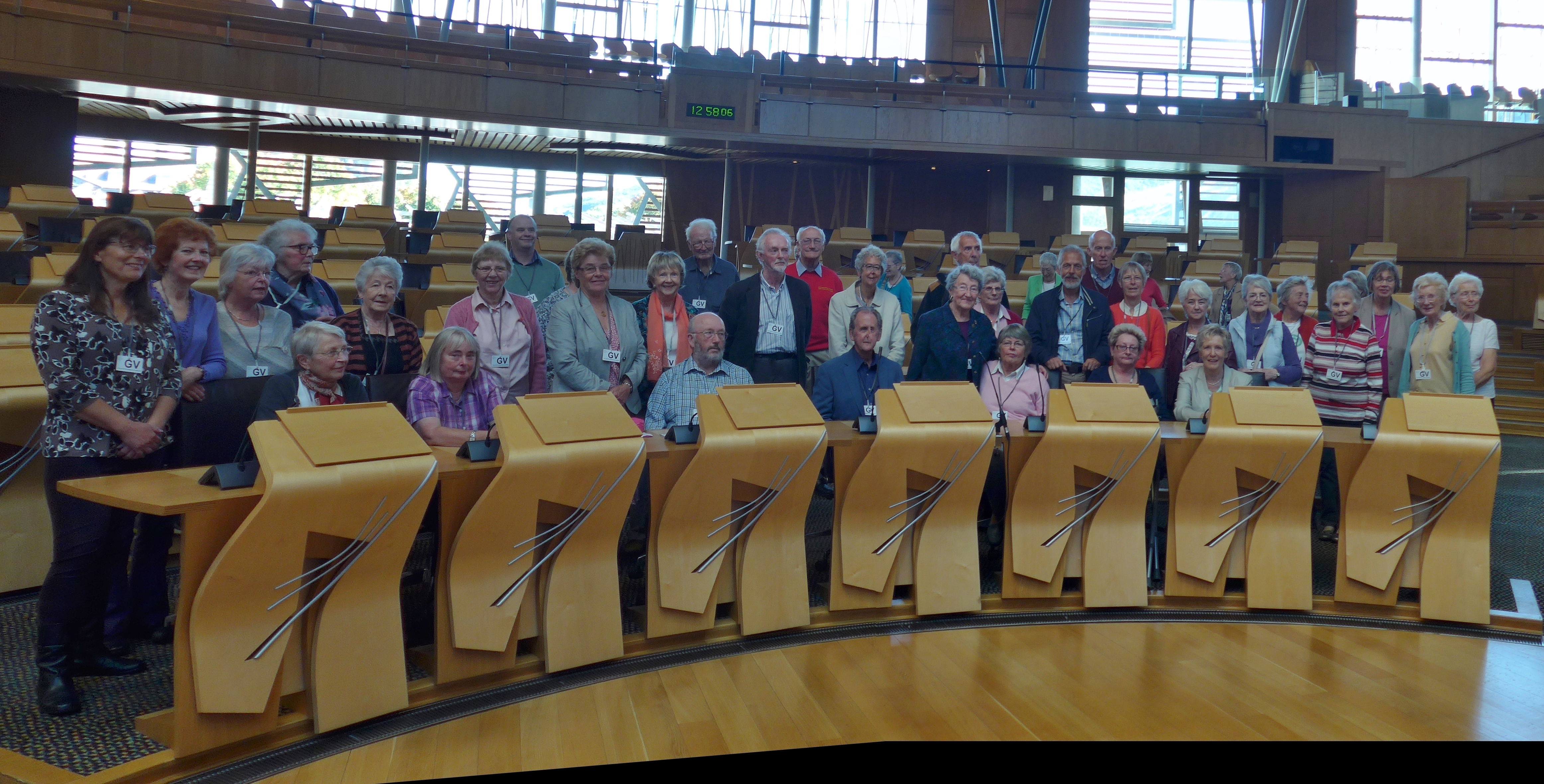
Parliament and Dynamic EarthAfter an early but bright start on Tuesday 29 September, some 40 members travelled to Edinburgh to visit the Scottish Parliament building and the Queen’s Gallery.

Alex Fergusson MSP for Galloway and West Dumfries welcomed the group in one of the committee rooms. Over tea and coffee he described his political career, including his term as Presiding Officer which he considered a privilege. However he has decided that he will not stand again at the election next year. He explained that the Parliament building was constructed on the site of a former brewery and as was obvious was a very complicated building but also incorporated Queensberry House, a Scottish vernacular building. The architect Enric Miralles died before the building was completed but the work was taken over by his wife and of course as was well known there was a massive cost overrun compared with the original estimate provided by Donald Dewar.

Front row!
Front row!

Mr Fergusson then escorted the group to the debating chamber where members were only too pleased to sit in MSP’s seats! He explained that the main parliamentary business days are Tuesday, Wednesday and Thursday afternoons but these debating sessions must finish at 5.00 pm which unfortunately had the result of curtailing the time for debates on important issues. However much of the important work of the Parliament is carried on in the various committees. A record of what is said in the debating chamber is recorded on video, by sound recording from the members’ microphones and by stenographers and is available the next day on the web. The recording of voting by members is also published.

The next visit was to Mr Fergusson’s office which most felt was very cramped even allowing for the “think pod”.

"think pod"
“think pod”

Over a sandwich lunch, Dr Howard Brown thanked Mr Fergusson for his welcome, the time he had devoted to the visit and for answering all the questions – something he said was so unusual for MSPs!!

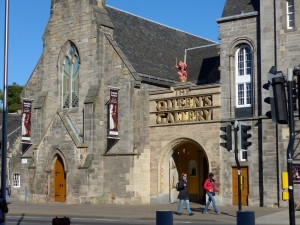
The group then went across to the Queen’s Gallery, Palace of Holyroodhouse to admire the paintings and other works in the exhibition, Scottish Artists 1750 to 1900. The paintings included portraits by Allan Ramsay of King George III and other members of the Royal family; The Penny Wedding by Sir David Wilkie; Flock of Sheep in a Blizzard by Joseph Farquharson; and watercolours by David Roberts of his visits to the East including one of the Treasury, Petra included in a book with a description of his visit.

Queen's Gallery
Queen’s Gallery

This was a very enjoyable outing again organised by Helen Henderson.

Sunshine in the Machars

Sunshine in the Machars

On a sunny Friday last week Gardening Group 1 were hosted by Andrew and Mary Gladstone at their 100 acre estate at Craichlaw House, Kirkcowan.

In their extensive grounds and against the backdrop of their historic ‘Scottish Baronial’ house, we enjoyed the colour and variety of perennials in the herbaceous borders, an amazing gravel border, the recently planted arboretum in the old walled garden before our walk by the water garden and round the loch.

Craichlaw House

Of the many wonderful gardens we’ve visited during the summer this was one of the most impressive and we’d hope to visit again perhaps for the rhododendrons season!


Stewartry U3A visits Tongland Power Station

Tongland Power Station

I’m sure many of you will have driven past the power stations and dams of the Galloway Hydroelectric scheme, especially the one at Tongland. U3A members were lucky enough to be allowed to visit the Tongland Power Station and the Dam in July. Although it is no longer manned, the original offices have been turned into a visitor centre which shows the history of the amazing project which was carried out in the early 1930s by two local men who required an Act of Parliament to be passed to make it happen. Our tour guide, Rowan Armstrong from the Galloway Fisheries Trust, took us through the original history and more recent history when all the systems were centralised at Glenlee, leaving the remaining five stations unmanned. The systems strategy to ensure the balance between power generation, flood control and fisheries management is delicate and our group had many questions. Most tours are for school children and I think we may have overwhelmed our poor guide – although she did say that the school children were easier to manage than the U3A group, some of whom managed to get lost on the way from the power station to the Dam. They were not generating while we were there, but we saw the turbines and learnt that they are substantially the same as when they were installed in 1934, no plastic or stainless steel to be seen.

The Dam is the most complex structure in the Scheme being a combination of arch dam and gravity dam and also having a long salmon ladder with many resting pools. Since 2007 they have been counting and tagging the salmon and trout to monitor their movements and numbers. Last year was very bad, but this year seems to be improving. The main threats are the weather (too hot or cold) and the American Signal Crayfish which disturb their traditional spawning areas in Loch Ken.

We did get to see the power of the water when the workers on the dam did some experimental releases, and you understand why it isn’t safe anywhere near there. It was a wonderfully informative tour, and if we are allowed back, we might arrange another one next year.

Helen Henderson (Events Organiser)


TRIP  TO VINDOLANDA  AND LANERCOST  PRIORY

Trip to Vindolanda and Lanercost Priory

On arriving at Vindolanda we were met by one of the archaeologists who gave us a brief introductory talk about the site. Vindolanda was named by the Tungrians a Belgian cohort who were the first to arrive at the site in the winter between 75-85AD. The name Vindolanda means white field or moor. The fort pre dates the wall, being built from stone quarried locally, to protect the Stanegate the road slightly to the north of the site, which runs from Corbridge to Carlisle.

The fort has been rebuilt nine times over the years, this makes the archaeology interesting but difficult to interpret as the new buildings were not built directly on top of the previous one. The fort follows the usual Roman playing card pattern. It is surrounded by walls which are still extant to about 1 ½ m. It contains granaries, barracks, and more unusually inside a fort a temple, this one dedicated to Jupiter Dolichenus, a weather god (perhaps seen as necessary by the continental soldiers living at the fort). The principia or commandant’s headquarters has a strong room, which is still visible, as are the two bath houses outside the walls. The archaeologists and volunteers are currently working on excavating the vicus, the large village outside the fort which grew up to service the soldier’s needs.

Archaeologists know that when digging Roman sites, they find many artefacts. Just before we arrived a volunteer had found a brooch, and whilst we were there volunteers were finding lots of black burnished ware a type of pot made on an industrial scale in the Nene Valley.

The Vindolanda site is unique because of the preservation of artefacts which would not normally survive. The anaerobic conditions have led to the preservation of many leather products, a sample of which are shown in the museum. They have a stunning collection of shoes and sandals, ranging from the first shoes worn by toddlers, fashion sandals, through to marching boots. Leather tents and horse trappings are other rare discoveries. The most special finds though are the Vindolanda tablets a series of post cards that had been written by the occupants of the fort, these include shopping lists and birthday invitations, so give us a good insight to life on the frontier.

At Lanercost we were met by John Lee the church warden who gave us an entertaining and informative talk on the history of the Priory. Lanercost Priory is a 12th-13th century Augustinian foundation, built largely from blocks stolen from Hadrian’s Wall. It has a turbulent history, being over the years visited by many monarchs from both sides of the border. During 1306-07 Edward I stayed for 6 months and as he had the privy seal with him he ruled England from the Priory. It was not only monarchs who left their mark at Lanercost, the outside of the church is pock marked with musket shot marks left by the local Militia mustered during the Napoleonic invasion scare.

The Monastic house was closed during the Dissolution and the north aisle of the Priory became the Parish church. In the 19th century George Howard 9th Earl of Carlisle commissioned work by leading Arts and Crafts designers, this includes a woollen embroidered Dossel. The Dossel has recently been restored at a cost of £66,000.

We then went to visit the Dacre Hall a late Medieval Hall built by one of the illegitimate children of the Howard family, where we had a welcome and much needed cup of tea and some delicious home-made biscuits.

Visit to the Devil’s Porridge Museum and Annandale Distillery

width="300"

The new Devil’s Porridge Museum is a far cry from the disused garage that it used to occupy. The past few years of fundraising and hard work have certainly paid benefits and we were fortunate to see it in the same week that it is die to be officially opened by Princess Anne.

The high-tech exhibits with plenty of touch screens and audio-presentations tell the story of HM Gretna, one of the biggest munitions factories in the world. It was set up in 1915 when it was clear that Britain would lose the war for lack of munitions. In record time Irish Navvies build not only the factory but a complete infrastructure including models housing, schools and shops. All that remains of this now are the villages of Gretna, Eastriggs and Dornock. The museum also tells the story of the Quintillshill trains crash, which happened on 22nd May 1915, exactly 100 years ago and is still the biggest loss of life in a train crash ever.

If you haven’t been it is a delightful museum with excellent refreshments and a friendly and well informed staff of volunteers.

??????????????????????????????????

A complete contracts was the visit in the afternoon to the newly re-opened Annandale Distillery. This originally opened in 1830 and was producing single malt whisky until it shut by Johnnie Walker in 1918. Professor David Thomson (incidentally Founder and CEO of the MMR Group) is a whisky enthusiast who saw the opportunity to convert it back from farm buildings to a distillery. The Visitor Centre is lovely, having been lovingly re-furbished by Kirkcudbright’s Ian Cameron-Smith and serves excellent refreshments, as we can attest. The tour shows how traditional materials have been used to produce the whisky (or spirit as it is currently). The copper stills were incredibly tactile and beautifully polished. Production started in 2014 with the first whisky being available in 2017/8, 100 years after the original closure.

We all had the opportunity to taste the spirit that they have for sale called Rascally Liquor, a white spirit at high proof which will eventually be put into the American Bourbon casks and become the peaty Man o’ Sword or the smooth Man o’ Words, references to the two local heroes Robert the Bruce, Earl of Annandale and Robert Burns, Bard of these parts.

Devils Trip to Porridge and Annan Distillery

Scottish Dark Skies Observatory Visits

On two evenings in late March intrepid volunteer drivers took a full minibus north into the Galloway Park hills to the UK’s only ‘gold tier’ dark sky observatory near Loch Doon. This is a rare facility where members of the public can star gaze using research quality telescopes and, with the resident astronomer, learn more about the universe and how to discover it.

Built in 2012, this impressive observatory has a 5m electronically controlled dome over a research quality 20″ telescope which is linked to software that can home in on and track stars and planets. A second, 14″ telescope is used to focus in on the moon and planets in greater detail.

Monday’s group were able to use the telescopes in periods when the clouds parted and were able to see a great view of Jupiter’s stripes and some of its moons.. The Wednesday group briefly spied an obscured moon, but had a fine appreciation from the viewing platform of the impact of light pollution, the sky to the north tinged with a pink-orange glow from the central belt. Both groups learned more about what can be seen on a clear night at the moment and how to make the most of our dark skies location. The next astronomical event to watch out for is the Lyrid meteor shower. The Lyrids offers 10 to 20 meteors per hour at its peak on a moonless night, which is the morning of April 22 or 23 in the western sky.

Despite the disappointing cloud conditions the groups enjoyed the evening and many will return when the weather looks
more promising, as booking at short notice is usually possible. Top tips: wrap up well and take a flask and a pair of binoculars to use while waiting your turn on the telescopes. Oh, and mind the track! Thanks to Helen our event organiser, our wonderful drivers Colin and John, and David and Fi at the observatory.

Eileen Johnson

Our Stirling Castle Trip

Stirling Castle Trip

There was so much to see at Stirling Castle, despite the occasional snow storm. Its history goes back over 2000 years and when you get to the top of the castle and look over the battlements you can see why – the view for miles and miles in every direction made it an impressive fortress. For those who hadn’t already seen the Great Tapestry of Scotland in New Lanark, it was splendid chance to browse in the magnificent Great Hall. This Hall has recently been completely restored by Historic Scotland with a replica hammer beam roof modelled on the original one in Edinburgh Castle. One theme throughout the tour was the damage done to the Castle by the military when they occupied it in the late 1700s. They removed the magnificent roofs, the Stirling Heads and anything that they feared would make their soldiers wallow in the luxury that the Stuart James’s had created.


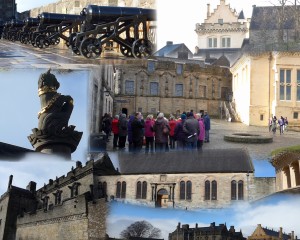
P1000742 Stitch CollageThe inside of the Royal Palace has recently been restored and can been seen much as it was on completion in 1545, however, all the furnishings were removed when James VI moved the court to London. Some examples of furniture are beginning to appear and many of the hangings and tapestries have been reproduced. The excellent costumed guides knew all about the Palace and what it would have been like to live there. The original Stirling Heads had been ripped down by the military and used for firewood, but some survived and are in the Gallery. The guide there had a very interesting commentary on the politics of the age and urged us to visit Argyle’s Lodgings (which many of us did) which had the history of its occupants including Sir William Alexander who was one of the founders of Canada as we know it today.


P1000806 CollageFor those interested in military history the Regimental Museum of the Argyll and Sutherland Highlanders was a splendid example of silverware and portraits. The Chapel Royal, which was hastily built in 7 months in 1594 is also being restored and the handsome interior frieze has been uncovered, painting over it was another of the military’s downgrading since they used the Chapel as an armoury. It is clear that Historic Scotland are spending a lot of time and money on the Castle and everyone agreed it is well worth another visit as there are constant changes and improvements.
Birdwatching outing to Loch Ryan

IMG_3237
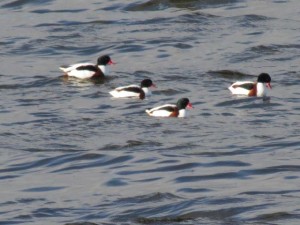
Sheld-ducks


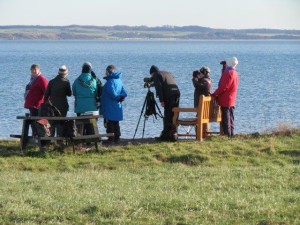
Enthusiastic birdwatchers


Birdwatching Group 2 led by Geoff Packard had an outing in glorious cold sunny weather to Loch Ryan on 5 February and were rewarding with good sightings of ducks, sea birds and waders.


IMG_3269
Birdwatchers with ferry in the background


Oyster Catchers
Oyster Catchers

U3A Wine Tasting Group

Stewartry U3A Wine Tasting Group

At their January meeting this group tasted some excellent Malbec wines and enjoyed a good selection of cheeses whilst discussing the wines presented by hosts, Chris and Jean Ingram. Of the three wines presented, the French Malbec just scraped in front but there was very little to choose between that and the Argentinian Malbec. Though the wines were quite different, both proved to be exceptionally good and much improved with the cheeses and sausages. The Spanish Malbec, though individually a good wine, was just in a different league to the French and Argentinian. This group can recommend all three Malbecs.